According to her, the international community is also somewhat
responsible for escalation of the crisis in Kosovo's north - "it has
not truly tried so far to place the north under control, which the
Serb side saw as an opportunity for secession of the north."
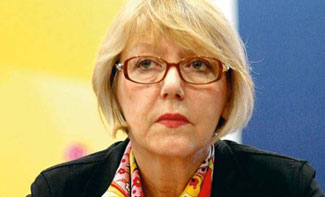
Sonja Biserko is a years-long chairwoman of the
Helsinki Committee for Human Rights in Serbia. And her public
statements have made her a target of strong criticism by Serbia's
nationalistic circles.
The latest bulletin of the Helsinki Committee
quotes that Serbia might be taken responsible for "consequent
destabilization" of the region. In your view, who's the key factor
of destabilization and what are his motives?
- Recent escalation of the tension in Kosovo's
north showed that the status quo in Kosovo is unsustainable and
hampers consolidation of Kosovo and Serbia alike. The international
community is also somewhat responsible for such a situation because
it has not truly tried so far to place the north under control,
which the Serb side saw as an opportunity for secession of the
north. In the past couple of months such a scenario has been openly
discussed not only by individuals from academic circles but also by
party leaders of the ruling coalition. All of them have turned a
blind eye to the international community's warning that borders in
the Balkans were final and that any partition scenario was out of
question for both Kosovo and Bosnia. Any change of borders would
destabilize the entire region of the Balkans, Macedonia and Bosnia
in the first place. It this context Belgrade has been warned that it
could be taken responsible for consequent destabilization. Hence,
the control that is now established over border crossings is
considered legitimate act and an act that preconditions the
implementation of Ahtisaari's plan in Kosovo's north as well. This
is more than obvious now after the visits by US and German's high
officials.
Serbia's powerful conservative bloc insists that
Kosovo is an inseparable part of Serbia. Other actors are also in
play here such as tycoons from Belgrade and groups in the Kosovo's
north - rule of law does not play into their hands as it jeopardizes
their interests. They've been harvesting huge funds that would have
otherwise gone to Kosovo's and Serbia's budgets.
Some analysts claim that today's Serbia is
pursuing Milosevic's policy of 1990s but by "different means." Are
they exaggerating?
- The fact remains that after October 5, 2000 with
the election of Vojislav Kostunica Serbia continued the same policy
by other means. However, there was another current within DOS
/Democratic opposition of Serbia/ helmed by late Premier Djindjic,
which realistically appraised Serbia's position and was committed to
the country's Europeanization. Unfortunately, that current has been
marginalized for years. The incumbent government has taken a
somewhat different attitude towards it by propagating a "European"
Serbia over the election campaign - which by definition implies
acknowledgment of regional realities. But it failed to make a fresh
advance in the matter of Kosovo and develop new policies for Kosovo,
Bosnia and the region as a whole. And that backfired on it now. I
hope that the continuation of Pristina-Belgrade dialogue scheduled
for September 2 would produce tangible results and that Belgrade
would seize this opportunity to present itself as a constructive
partner, who has fully understood the message about Kosovo's north.
We witness some changes in the power structure
within EU, as well as the consequences of the economic crisis.
Germany seems to be taking over the main role in EU foreign policy
and that for the Balkans. At least that's how some people interpret
the planned visits to Balkan countries. To what extent this possible
change could be reflected on EU's attitude towards Serbia?
- Like the entire world, EU is undergoing
transformation and searching for a new paradigm. That's a complex
process implying many drawbacks as well. What we have now is a
reshuffle and redistribution of power. That's why the Balkans has
been on the agenda for so long. Consolidation of EU will also help
put an end to the Balkan question. No doubt that Germany is a
driving force within EU and among most important member-states as
such. Visits by German Foreign Minister and the Chancellor testify
of Germany's active return to the Balkans. That was evident during
the crisis in Kosovo's north. I think that's a good sign, which will
speed up the denouement of regional processes. That will also affect
Serbia and it would be good for it to adjust its stands with those
of the most powerful EU country, rather than with Greek or the like.
What matters at this point is that the government acknowledges all
the messages it got this summer and courageously starts moving
towards compromises and solutions.
Do you take that the rhetoric of some regime
politicians hints at a change of foreign policy course and
distancing from EU or just collects political points for the
upcoming elections?
- EU is Serbia's only valid alternative. Any other
would mean isolation Kostunica and circles close to him would only
be glad to see. Judging by the rhetoric one can only conclude that
the election campaign is already on, a campaign that is more
populist and offensive to citizens' common sense than the one
before. Political elites are again fueling the basest stereotypes
and underestimating people's common sense. And that's surely not a
good policy for voters' mobilization. Citizens want to see concrete
offers. The government must replace empty words about a pro-European
Serbia with concrete actions to convince us that it means what it
says.
There has been much talk about "a big
coalition," the one between DS and SNS, after the elections. Some
are ruling out such a possibility. In Serbia we have witnessed all
sorts of political surprises. Could this be another one?
- All that speculation about possible coalitions
is a part of the election campaign. A big coalition and all that
talk about unity, "togetherness," is what Kostunica has advocated
once. It would be good had Serbia already reached a political
consensus on its future in Europe. But as things stand and judging
by the rhetoric of some coalition leaders not even the incumbent
government is quite sure about it. What I want to say is that this
pro-European tendency is still fragile in Serbia but enjoys more
support among citizens than among elites. I don't believe in the
possibility of the so-called big coalition. It would slow down
Serbia's anyway snail-paced movement towards European integrations.
I believe some pro-European coalition would emerge from the upcoming
elections, a coalition that would be pushing Serbia on a desirable
course with more courage and resoluteness.
Some intellectual circles claim that at present
the society as a whole is a bigger barrier to Serbia's pro-European
integration than politicians. It used to be the other way round
once. All in all, how can one change an entire society? Is that a
lost battle the more so since we have been witnessing many
retrograde trends? I would like your opinion about it in the context
of the announced Pride Parade.
- I wouldn't say such claims are valid. Elites are
more responsible for Serbia's present and future than citizens. By
not doing and flirting with the nationalistic project and retrograde
trends they have contributed to the present situation. They have
refused to acknowledge that Milosevic's ideology - the one that
ended up in crime - was defeated. How can one expect more liberalism
from citizens who are day in day out bombarded with the theses about
them as victims and a global complot against Serbia. The issue of
the Pride Parade belongs to this context. In the entire region (and
beyond it) the attitude of the great majority of population towards
LGBT persons is negative. It can be changed only through a changed
behavior of the media and elites. That's the way to shape the
attitude towards the "other" - either towards LGBT population or
some other minority group. It is because the general public
gradually learns the accept differences that the Pride Parade is so
important.
Nedim Sejdinovic |