|
Purpose
This Non-Paper is intended for domestic and
international social, business, political, and other stakeholders
whose actions influence the course of the ongoing crisis in Serbia.
The document is based on available information
regarding the severity of the crisis, the state of security in the
country, and political will, preparedness, and capacity of various
actors to help preserve peace and stabilize the situation.
A. Serbia Facing Structural Destabilization
Political and social crises, coupled with growing
security instability, have come to dominate everyday life in Serbia.
The government’s response has included measures reminiscent of a
state of emergency and a creeping coup, raising the risk of further
escalation.
President Aleksandar Vučić remains one of the most
influential actors in this crisis. He has consolidated control over
the media, key budgetary and investment decisions, and the
management of the Serbian government, particularly its diplomacy,
the military, and the police. The president is using this authority
to advance the values and interests of a single segment of society
and to build the Movement for the Defense of the State. His conduct
violates both the letter and the spirit of the Constitution and the
Law on the President, which define the president’s primary duty as
safeguarding the unity of the state.
Public protests and widespread sentiment challenge
the legitimacy of such conduct, raising calls for current
president’s resignation or impeachment, and for extraordinary
presidential elections. There is an emphasized need to undertake
appropriate activities to strengthen political will and reach a
political agreement on the conditions for electoral verification of
the government.
B. Activities and Mechanism for a Peaceful
Exit from the Crisis
B.1 Measures for De-escalating Threats to
Human Security
Independent Expert Commission: Establish
a body to monitor and report on social conditions and security
trends, and propose measures for de-escalating threats to human
security, human rights, and freedoms. The Commission should
cooperate with domestic and international experts, institutions, and
organizations, supporting the work of an Ad Hoc Mechanism for
Facilitating a Peaceful Exit from the Crisis.
Countering advocacy of intolerance,
violence, and extremism: All competent institutions must take lawful
measures to suppress advocacy of intolerance, hatred, and extremism;
to stop the increase in police violence; and to prevent the abuse of
prosecutorial and judicial functions, including misdemeanor courts.
Role of the President and National
Security Council: Adopt measures to stop the increase of police
violence and torture. Take measures to dismantle para-police groups
and stop their activities and violence —especially those supported
by the ruling parties, funded through misuse of public resources or
illicit means, supported by the police, and tolerated by parts of
the judiciary.
Role of the Supreme Public Prosecutor’s
Office: Fulfil legal obligations to combat extremist and para-police
activities, especially those connected to political parties, public
officials, and organized crime.
Parliamentary and institutional
oversight: Activate existing mechanisms for parliamentary and other
forms of public oversight over the security and intelligence
community in Serbia, especially the police and the Security
Intelligence Agency (BIA).
Assessment of institutions of special
public importance: Urgently review whether the key institutions—
Constitutional Court, Anti-Corruption Agency, Commissioner for
Information of Public Importance and Personal Data Protection, and
Protector of Citizens—are fulfilling their constitutional and legal
mandates and effectively contributing to the protection of human
security, rights, and freedoms in Serbia.
National Security Agency: Consider
establishing an agency legally designated as one of key actors in
upholding the rule of law, responsible for providing critical
security and defense information to authorized institutions,
countering cyber and communications threats, protecting individuals
and facilities, safeguarding the national currency and payment
systems, and leading or assisting in investigations into war crimes,
terrorism, and politically motivated murders.
Police reorganization: Create legal and
operational conditions to reorganize the police into a single
structure with a unified chain of command and management.
B.2 Roundtable on Stabilizing the Situation
in Serbia
The Roundtable on Stabilizing the Situation in
Serbia is an ad hoc mechanism that enables reaching a political
agreement to overcome the current legitimacy crisis and
irregularities in the work of the National Assembly of Serbia,
Assembly of AP Vojvodina, city and municipality assemblies, as well
as local community councils throughout Serbia.
Rationale:
Deep political and social divisions;
High public distrust in authorities;
Conflict between the opposition and the
government;
Limited crisis capacity management on
both sides;
Lack of acceptable institutional
framework for dialogue;
Risk of radicalization, parallel
institutions, and violent resistance;
Infiltration of para-state structures and
organized crime into state institutions, especially in the security
and intelligence sector.
Goals:
Reach political agreement on conditions
for fair and democratic elections;
Ensure peaceful, democratic resolution of
the political and security crisis;
Establish basic rules and mechanisms to
reduce tensions and security risks.
Participants:
Representatives of protesting citizens,
civic initiatives, student, professional, local, and other movements
with significant public support;
Parliamentary political parties.
Moderation:
Moderator of the Roundtable may be an
individual or a collective body, either a Serbian citizen and/or a
representative of the international community (the Quint is
recommended).
Moderator selection requires unanimous
approval of all participants.
Expected outcome:
Consensus on creating conditions for free
and fair elections, including:
Integrity of voter register and
prevention of biometric and data abuse;
Independent monitoring of the activities
of the Republic Data Center;
Decision on the electoral system model
(majority or proportional);
Introducing larger number of electoral
districts;
Direct voting procedures and ballot
security;
Balanced regional and minority
representation;
Financing of political parties and
campaigns.
Recommendations:
The National Assembly elected in early
elections should serve as a constituent assembly;
It is necessary to set a specific
timeframe for the transitional period. For the president and the
constituent assembly, this period should be shorter than the term
established by law for those elected in regular elections;
Reaching an agreement on the schedule for
holding extraordinary elections at all levels.
C. Role of the President in Serbia’s
Stabilization
Given the serious security challenges facing
Serbia and the need to prevent further destabilization, particular
focus is on the role of the president, National Security Council,
and the security and intelligence community in Serbia.
Public debate frequently raises the question: Who will replace
Vučić? This Non-Paper does not answer this question but stresses the
need for electoral change of this function and outlines tasks for
the president to ensure a peaceful, democratic transfer of power and
stabilization in the country.
It is the Responsibility of the President of the
Republic of Serbia to:
Initiate measures to guarantee the
property rights of citizens, public and state property, as well as
the property of companies and cooperatives, legacies, and more;
promote an effective restitution process to return unjustly taken
property to its rightful owners.
Support the creation of an environment
fostering business, political, and social cooperation, respect for
the rule of law, institutional recovery, and solidarity.
Encourage dialogue on Serbia’s Reform and
Sustainable Development Strategy for the coming decade, involving
the businesses community, experts, civil society, and international
partners.
Support opening Serbia to multinational
corporations that contribute to sustainable development, while
respecting the interests and needs of domestic economy and the
public, especially in strategic sectors, such as, food production,
water management, mining and processing of rare metals, energy, and
human security.
The Law on the President and other
related laws should clearly define the President’s rights, duties,
and responsibilities to uphold the Constitution, laws, and strategic
documents essential for Serbia’s sustainable development, stability,
security, and defense. The President must adhere to these
responsibilities when deciding on granting a mandate to form the
government, approving laws, and appointing Constitutional Court
judges and diplomatic representatives.
When signing decrees promulgating laws,
the President is obliged to provide explanations for the decision to
give consent and point out appropriate and necessary amendments to
the law and Constitution.
Contribute to strengthening judicial
independence; eliminate the practice of protecting acquired
privileges and monopolies; prevent the National Assembly from acting
as a “party personnel filter” in the judiciary.
Provide support to judicial and
investigative authorities in combating corruption, organized crime,
and terrorism, directly and/or through the National Security
Council.
Initiate comprehensive monitoring,
review, and reporting on cooperation with foreign intelligence
services; initiate ending the practice of involving BIA and VOA
members in prosecutorial teams and overseeing prosecution work;
initiate removing VOA’s influence over the War Crimes Prosecutor’s
Office.
In carrying out duties of appointments
and awards, the President is obliged to respect and is accountable
for the integrity of the individuals being appointed or honored.
Respects diversity and promotes the
integrative policies. Given the importance of interethnic relations
for Serbia’s development, stability, and security, and considering
the prolonged inactivity of the National Council for National
Minorities, the President of the Republic should be legally
authorized to chair this Council.
D. Urgent Measures
The Law on the President of the Republic should
clearly define, in line with the Constitution and other laws, the
criteria for granting amnesty and pardon, along with the President’s
accountability for failing to adhere to these criteria.
It is necessary to examine the President’s past
actions in relation to sustainable development issues, with an
immediate focus on halting the President’s involvement in bodies and
institutions that approve major capital investment projects.
It is necessary to ensure adequate infrastructure
and human resources to enable effective performance of the
President’s public duties. To this end, a review of the legal status
and responsibilities of the National Security Council is required,
recognizing it as a key body for improving security conditions and
guiding the activities of the security and intelligence community.
Members of the National Security Council can only
be worthy citizens of Serbia, with proven qualifications and
experience in the fields of strategic planning and directing
security development in all its aspects.
The Council should be chaired by the President of
the Republic and/or the Security Adviser to the Republic of Serbia.
The current Bureau for Coordination of Security
Services should be replaced by a Bureau for Coordination of
Activities of the Intelligence and Security Community. Its members
should be representatives from the National Assembly, the Government
of Serbia, and the Ministries of Foreign Affairs, European
Integration, Internal Affairs, and Defense. The existing Bureau for
Coordination of Security Services should be transformed into a
Coordinating Body of the Intelligence and Security Community,
composed of the heads of security and intelligence agencies.
For the Ad Hoc Team of Experts on Security
and Stabilization
Belgrade, August 13, 2025
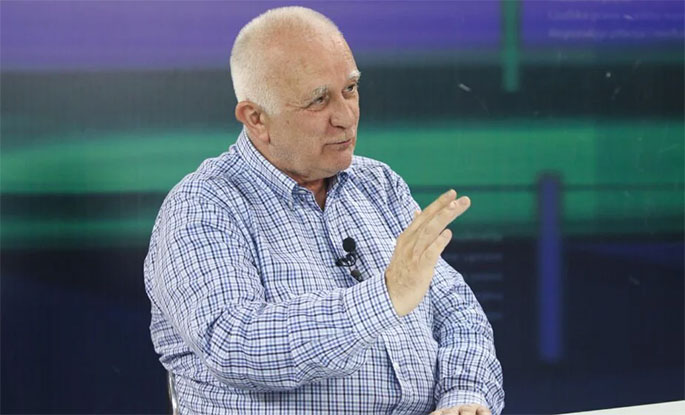
Dr. Dušan Janjić
|