|
Student and civic protests in Serbia have not
subsided even after the mass Vidovdan rally; on the contrary, they
are justifiably escalating, as they have been provoked by the
authorities. They reflect deeply rooted dissatisfaction with the
regime, systemic violence, elections lacking integrity, and general
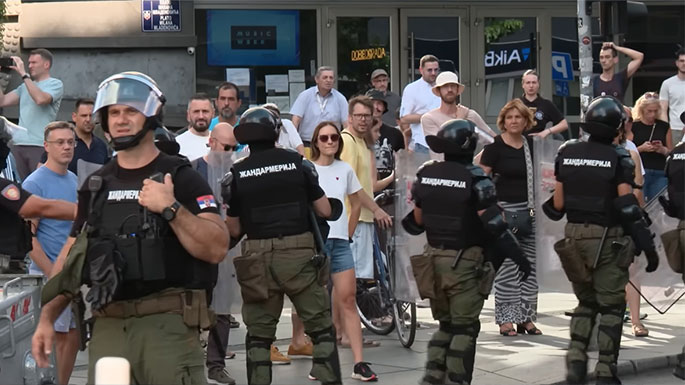
societal stagnation and hopelessness. The police violence, which
intensified after June 28, clearly shows that the regime relies
solely on the monopoly of force — and that under direct instructions
from the president. This is the most serious indicator yet of an
authoritarian shift.
If the repression continues and is not met with
clear political resistance, Serbia is irreversibly sliding toward
open autocracy with all the elements of dictatorship. This includes
further erosion of institutions, particularly the judiciary and
media; continued radicalization and division of society, where the
space for dialogue is replaced by sheer repression and escalating
violence; the looming further isolation of Serbia, as the disregard
for democratic standards, in the long term — if not permanently —
distances the country from the EU; and an enormous rise in the risk
of regional destabilization, especially if the government resorts to
"foreign policy crises" (Kosovo, Bosnia and Herzegovina) to divert
attention from overwhelming internal problems.
The situation increasingly resembles patterns seen
in known hybrid regimes: repression as a response to demands for
basic rights, while the government employs rhetoric of stability and
patriotism. If citizens and civic structures remain persistent and
principled, a turning point is possible — though it will come at a
cost and will require more decisive international support, which
must be provoked by clear and unequivocal steps from within.
The international community, primarily the EU
unfortunately, is currently showing limited interest, partly due to
geopolitical priorities and the usual perception of Serbia as a
“stabilitocracy.” However, silence can further encourage repression
and discourage civic resistance. The EU not only has an obligation
but is in the best position to objectively assess the situation and
respond accordingly, considering that Serbia is a candidate for EU
membership.
It is essential that the EU act in Serbia before
it is too late. It has all the necessary tools at its disposal, and
its mediating role — akin to a “new Gonzalez” — in establishing
political dialogue in a deeply divided country, and in guiding
society out of crisis, objectively has no alternative.
|